If your home runs on a septic system, you've probably heard the term "conventional system" at some point. But depending on where your property sits in Polk, Hardee, or Hillsborough County, a conventional septic systems types may not be what's in your yard, and it may not be the right fit if you ever need a replacement.
Florida's soil conditions, high water table, and heavy rainfall make septic system selection more complicated here than in most states. The system type on your property affects how you maintain it, how long it lasts, and what options you have when something goes wrong.
Here's a plain-language breakdown of the most common septic system types in Central Florida, how each one works, and which conditions call for which system.
How Every Septic System Starts
All septic systems follow the same first steps. Wastewater leaves your home and flows into a septic tank. Inside, solids sink to the bottom as sludge, and grease floats to the top as scum. The liquid in the middle, called effluent, eventually flows out for further treatment or dispersal.
What happens to that effluent after the tank is where system types split. Some rely on the soil to do the treatment work. Others treat the wastewater first, then disperse it. The right approach depends on your lot size, soil type, and how close the water table sits to the surface.
The Main Septic System Types in Central Florida
Central Florida properties use several different system types, and the right one depends on the specific conditions of each site. Here's how the most common options work and when each one applies.
Conventional Systems
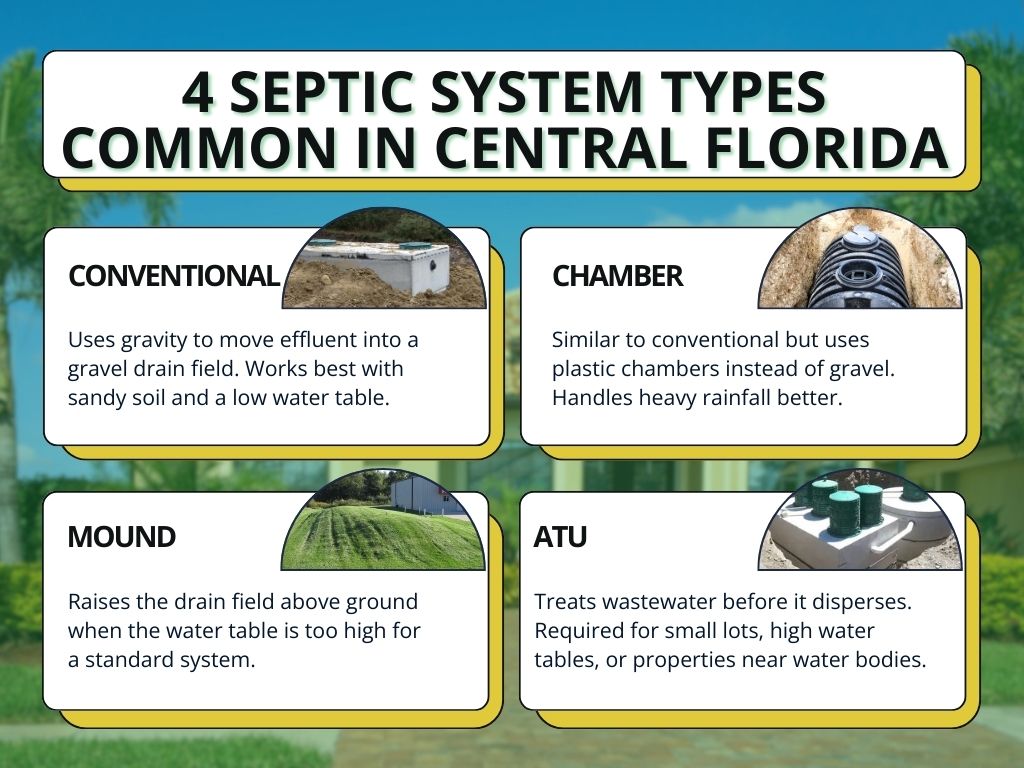
The most common type in the area. Effluent flows from the tank by gravity into a drain field. The drain field is a network of perforated pipes in gravel-filled trenches. The soil filters the effluent as it disperses underground.
Conventional systems work well where soil drains well, and the water table sits low enough for safe absorption. They have the fewest mechanical parts, which keeps maintenance simple and costs predictable. For properties in Bartow, Plant City, and parts of Lakeland with sandy soil, this is usually the go-to choice.
The limitation: they need enough space and the right soil conditions. When those aren't available, a different system is needed.
Chamber Systems
Chamber systems work much like conventional systems but swap gravel trenches for plastic chambers placed directly in the soil. Effluent disperses from the bottom and sides of each chamber into the surrounding ground.
They handle heavy rainfall well. That matters in Central Florida, where the rainy season runs May through October, and soil saturation is a real concern. For most homeowners, the choice between a gravel system and a chamber system comes down to site conditions and the installer's recommendation.
Mound Systems
When the water table is too high or the soil too shallow for a standard drain field, a mound system raises the drain field above the natural grade. Sand builds up a raised bed, and a pump moves effluent from the tank up into the mound. The effluent filters through the sand and then reaches the native soil below.
That elevation provides the separation from groundwater that the system needs to treat effluent safely. Mound systems take up more space than conventional systems and include a pump, which adds an electrical component and slightly higher maintenance costs.
Advanced Treatment Units (ATUs)
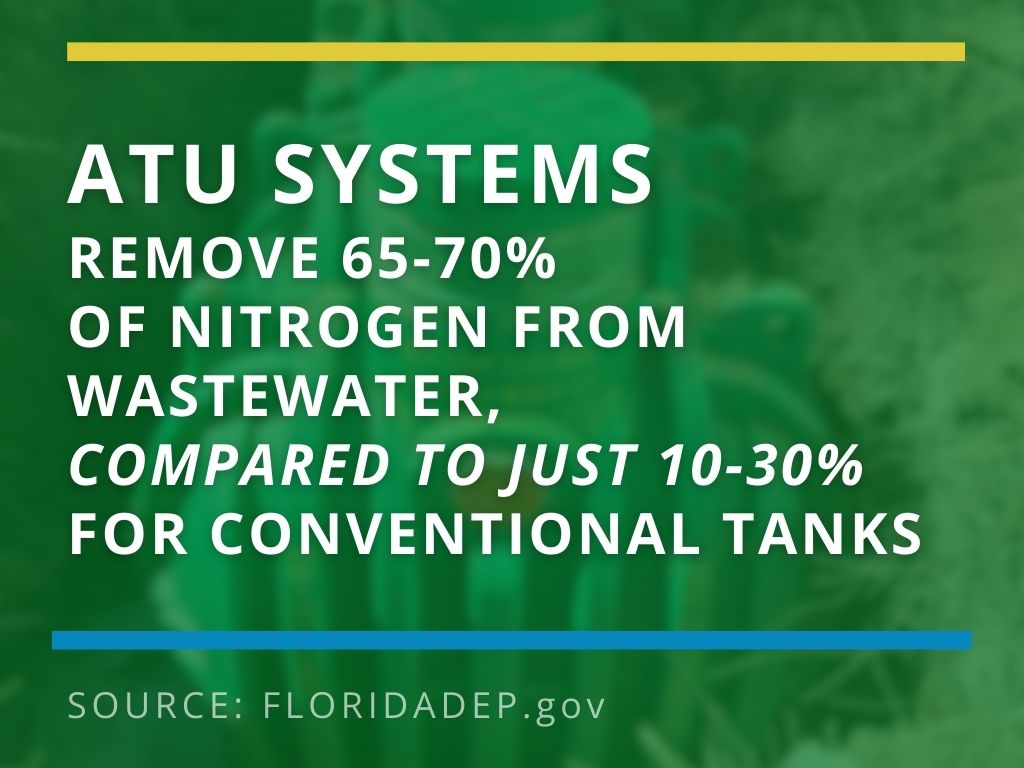
ATUs treat wastewater before it disperses rather than letting the soil do most of the work. An aerator pumps oxygen into the treatment chamber. That oxygen creates conditions where bacteria break down waste far more thoroughly than in a standard septic tank. The result is a much cleaner effluent that can safely disperse in conditions where conventional systems fall short.
ATUs are commonly required in Central Florida when:
- The lot is too small for a conventional drain field
- The water table is too high for standard soil absorption
- The property sits near a lake, pond, or other water body
- A previous system has failed, and soil conditions block a standard replacement
Because ATUs have mechanical parts, Florida law requires a maintenance contract and at least two service visits per year to stay in compliance with Department of Health standards.
Commercial Septic Systems
Commercial properties handle far more daily wastewater than a typical home. A single-family residence may produce 40 to 80 gallons per day. A restaurant, office building, or apartment complex can produce several hundred to several thousand gallons. That volume difference shapes nearly every aspect of how a commercial system gets designed.
Commercial systems follow the same basic process as residential ones, but with key differences:
- Tank size: Commercial tanks are much larger to handle higher daily flow. Systems exceeding 5,000 gallons per day fall under Florida DEP jurisdiction rather than the county health department.
- Drain field sizing: Engineers size commercial drain fields to match waste volume and type, not just lot size.
- Grease management: Restaurants and food service businesses need grease traps to keep fats and oils out of the tank and the drain field.
- ATUs for industrial use: Properties with specialized waste streams or sites near sensitive water bodies often need an ATU for additional treatment before dispersal.
- Permitting and compliance: Commercial installations involve Florida DOH and, in some cases, DEP, with documentation requirements that go well beyond a standard residential permit.
For business owners in Lakeland, Winter Haven, Brandon, and the surrounding area, commercial septic work calls for a contractor who understands both the engineering and the compliance side of the process.
How Florida’s Conditions Shape the Decision
In most states, a conventional system is the default for nearly every residential property. In Central Florida, site conditions make that less reliable as a starting assumption.
| Factor | How It Affects System Choice |
| High water table | Limits drain field depth; may require mound or ATU |
| Sandy soil | Good drainage; often supports conventional systems |
| Heavy rainy season | Soil saturation can stress any drain field May through October |
| Small lot size | May not have room for a conventional drain field |
| Proximity to water bodies | Often triggers stricter treatment requirements, typically ATU |
Water table depth across Polk and Hillsborough Counties varies significantly, even within short distances.
A property near a Winter Haven lake chain may face very different conditions than one a few miles away in a higher-elevation part of Bartow. A site evaluation is always needed before a new system is installed or replaced.
What Type of System Do You Have?
Many Central Florida homeowners don't know exactly what's on their property, especially in older homes. A few ways to find out:
- Permit records: The Florida Department of Health county office keeps records of permitted septic installations. Polk, Hillsborough, and Hardee County offices can tell you what permit covers your address.
- Look for an electrical panel or alarm: A control box, float alarm, or timer near the tank area usually signals an ATU or pump-based system, not a simple gravity-fed conventional setup.
- Schedule an inspection: A licensed technician can assess your tank, drain field, and system components and give you a clear picture of what you have and how it's performing.
Knowing your system type matters for maintenance planning, pump-out scheduling, and understanding your options if a repair or replacement ever becomes necessary.
Related Questions
How often does a septic system need to be pumped?
Most residential tanks in Florida need pumping every three to five years, depending on household size, water usage, and tank capacity. ATU systems may follow different schedules tied to their required maintenance contracts.
What are the signs a septic system needs attention?
Slow drains, gurgling pipes, sewage odors indoors or in the yard, soggy ground over the drain field, and sewage backing up into the home are all warning signs. Any of these calls for a professional evaluation.
What maintenance does an ATU need versus a conventional system?
ATUs need a maintenance contract and at least two service visits per year under Florida law. A technician checks the aerator, pump, and effluent quality at each visit.
Conventional systems have no such requirement, though regular pumping every three to five years remains essential for protecting the drain field.
When to Call a Professional
If you don't know what type of system you have, a professional assessment is a smart starting point before any issues develop.
Knowing the system, its age, and its current condition helps you plan maintenance and avoid expensive surprises.
If you're planning a new installation, dealing with a failing system, or purchasing a property in Lakeland, Bartow, Winter Haven, Brandon, Valrico, or anywhere across Polk, Hardee, or Hillsborough County, a licensed inspection is the right first call.
Conclusion
Septic systems types aren't one-size-fits-all, and that's especially true in Central Florida. Soil conditions, water table levels, lot size, and proximity to water bodies all play a role in determining what belongs on a given property. Understanding the differences helps you take better care of what you have and make smarter decisions if something ever needs to change.
Septic Services of Central Florida is a family-owned company based in Bartow with over 35 years of combined experience serving Polk, Hardee, and Hillsborough Counties. From new installations and ATU service to pumping, drain field repairs, and real estate inspections, the team is here to help.


