Learning how to find septic tank lids and access points is one of the most important tasks for a homeowner in Central Florida. Whether you just moved into a new home in Ocala or you have lived in Lake County for years, knowing the exact location of your system is essential for proper maintenance.
Most people do not think about their septic system until there is a backup in the house. By then, the cost of repairs is often much higher than a simple pumping visit.
At Septic Services of Central Florida, we see many homeowners struggle to find their tanks because they are buried deep under the grass or hidden by landscaping. This guide will walk you through the best methods to locate your tank and explain why having this information is vital for the long-term health of your property.
Why Does Locating Your Septic Tank Matter?
You might think that if the toilets are flushing, you do not need to worry about where the tank is located. However, a septic tank is a living biological system that requires regular attention. To keep it working correctly, you must have it pumped every three to five years. If an inspector or a pumper cannot find the tank, they cannot do their job.
Finding the tank also helps you protect it from damage. Septic tanks and drainfields are not designed to hold the weight of heavy vehicles or structures. If you do not know where the tank is, you might accidentally park a truck over it or build a shed on top of it.
This can crack the tank or crush the pipes in the drainfield. In the sandy soil of Central Florida, these repairs are expensive and can often be avoided with a little bit of knowledge.
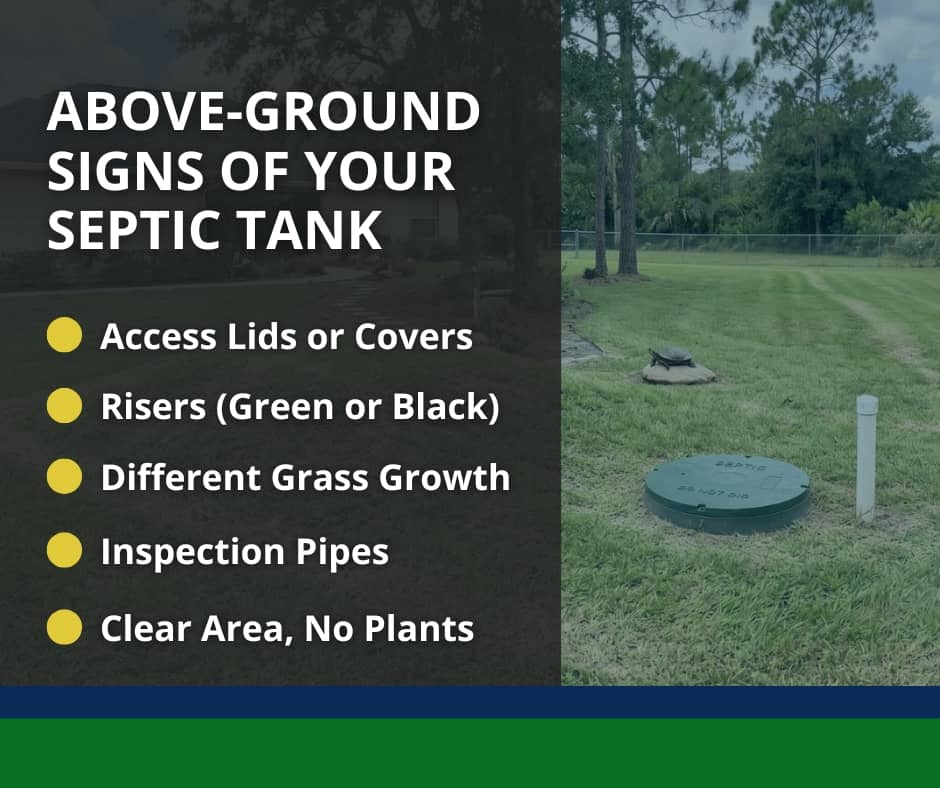
Visual Clues to Help Find Your Tank
The easiest way to start your search is by looking for visual signals on your lawn. Because the septic tank is buried a few feet underground, it often changes the way the grass looks above it.
Follow the Main Sewer Line
Inside your home, find the largest pipe in your crawlspace or basement. This is the main sewer line. It usually exits the house through the foundation toward the backyard or side yard. Once you find where the pipe leaves the house, you can follow that line straight out into the yard. Most septic tanks are located between ten and twenty feet away from the house.
Look for Unnatural High or Low Spots
Sometimes, the soil over a septic tank will settle over time. This creates a slight dip in the grass. In other cases, there might be a small mound where the tank was installed. If you see a rectangular-shaped depression in your yard that is about five feet by eight feet, there is a good chance your tank is right underneath.
Check the Condition of the Grass
The grass over a septic system often looks different than the rest of the yard. During a dry Florida summer, the grass over the tank might turn brown faster because the soil is shallower.
However, if the tank is full or leaking slightly, the grass might look much greener and grow faster than the surrounding area. This "lush" spot is a common indicator of where the system is buried.
Searching for Property Records and Maps
If visual clues do not work, your next step should be to look at official paperwork. When a septic system is installed in Central Florida, the contractor must file an "as-built" drawing with the local health department.
These drawings are essentially a map of your property. They show exactly where the tank is located in relation to the house, the well, and the property lines. You can often request these records from the Florida Department of Health office in your specific county. Having this map on hand makes it much easier for the team at Septic Services of Central Florida to perform an inspection or repair.
If you cannot find an as-built drawing, look at your home’s original blueprints or the home inspection report from when you bought the property. Many inspectors will note the general area of the septic tank in their final report.
More Technical Ways to Find a Septic Tank
If you are still having trouble, you may need to use some basic tools to find the edges of the tank. Professionals use these methods every day to save time and avoid digging up the entire yard.
The T-Probe Method
A soil probe is a long, thin metal rod with a handle at the top. You can gently push this rod into the ground in the area where you suspect the tank is buried.
When you hit something solid about two to four feet down, you have likely found the top of the tank. By probing in several spots, you can map out the rectangular shape of the tank and find where the lids are located.
Electronic Locating
At Septic Services of Central Florida, we often use electronic locating tools for tank location and inspection. We can flush a small "sonde" or transmitter down a toilet. This device travels through the pipes and stops when it reaches the tank.
We then use a receiver on the surface to pinpoint exactly where the transmitter is located. This is the most accurate way to find a tank without any digging at all.
| Method | Ease of Use | Accuracy | Cost |
| Visual Clues | Easy | Moderate | Free |
| Property Records | Moderate | High | Small Fee |
| Soil Probing | Physical | High | Low |
| Electronic Locating | Professional | Highest | Moderate |
Locating the Tank Lids
Finding the tank is only half the battle. To pump the system, we need to reach the lids. Most modern septic tanks have two lids. One is over the "inlet" side, where the waste enters from the house. The other is over the "outlet" side, where the liquid flows into the drainfield.
Lids are usually made of concrete, plastic, or fiberglass. In older homes, these lids are buried under several inches of dirt. During a professional service, we can install "risers." Risers are plastic tubes that bring the lid up to the surface of the ground. This makes future maintenance much easier because you will never have to dig your yard up again to find the access points.
The Challenges of Central Florida Soil
Central Florida has very sandy soil and a high water table. This makes septic maintenance different from that in other parts of the country. In areas with clay soil, a tank might stay in place for decades without moving. In our sandy environment, the soil can shift or wash away around the tank over time.
Because our water table is so high, especially during the rainy season, a buried tank can actually "float" if it is empty and the ground is saturated with water. This is why you should always have a professional handle your pumping.
If an amateur pumps a tank during a heavy Florida rainstorm, the entire tank could pop out of the ground like a cork in a bottle. Septic Services of Central Florida understands these local risks and knows how to safely manage your system in any weather.
Related Questions to Explore
Can I use a metal detector to find my septic tank? Most septic tanks are made of concrete or plastic, so a metal detector will not find the tank itself. However, it might pick up the rebar inside a concrete lid or the metal handle on the access point. It is not always the most reliable method.
How deep is a septic tank usually buried? In Central Florida, most tanks are between one and three feet underground. If the tank is deeper than three feet, it usually requires a riser to be accessible for pumping and inspections.
What is an Advanced Treatment Unit (ATU)? An ATU is a more complex septic system that provides a higher level of wastewater treatment. These are becoming more common in Central Florida near sensitive water bodies. These systems require more frequent inspections and have specific components that must be located for service.
What happens if I cannot find my septic tank at all? If all other methods fail, a professional septic company can use a sewer camera. We can run the camera through your plumbing from the house. Not only does this show us the path to the tank, but it also allows us to check the condition of your pipes for clogs or breaks.
When to Call a Professional
Locating a septic tank can be a fun DIY project, but it often becomes frustrating. If you have been probing your yard for an hour and still have not found anything, it is time to call for help. Digging in the wrong spot can lead to damaged pipes or even a punctured irrigation line.
You should contact Septic Services of Central Florida if:
- You cannot find your tank lids, and your system is due for pumping.
- You are planning to build a pool, deck, or fence and need to mark the system.
- You notice slow drains or gurgling sounds in your plumbing.
- You have a "wet spot" in your yard that never seems to dry out.
- You need to locate a system for a real estate transaction or a permit.
Our team has the specialized equipment to find even the most deeply buried tanks. We provide thorough pumping, inspections, and repairs for both residential and commercial properties throughout the Central Florida region.
Conclusion
Knowing how to find septic tank locations on your property is a vital part of being a responsible homeowner. It allows you to stay ahead of maintenance and protects your yard from expensive damage. By using visual clues, property records, and professional tools, you can take the mystery out of your septic system.
Whether you need a routine pumping or a complex drainfield repair, Septic Services of Central Florida is here to support you. We take pride in helping our neighbors in Lake, Marion, and Sumter counties keep their systems running smoothly.
Do not wait for a backup to happen before you learn where your tank is located. Reach out to our team today to schedule an inspection.


